Witness Dinosaur Encounters Wednesday-Sunday in the North American Mammal Hall, Level 2.
Learn more >
Witness two enormous dinosaurs facing off in the Ground Level's Grand Foyer. Our dynamic Dueling Dinosaurs display features replicas of the authentic T. rex and Triceratops specimens from our collection. Outside the Museum near Exposition Boulevard, check out the bronze dinosaurs — they're fleshed out versions of the interior Dueling Dinos.
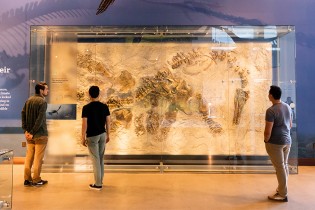
Three of our best dinosaur specimens are on exhibit upstairs on Level 2, inside the North American Mammal Hall: a T. rex skull, a Triceratops skull and a rare full-body specimen of a South American Carnotaurus.
We’ve sent them to our Dino Lab where they are taking a little vacation from being on exhibit. We’re enthusiastically anticipating their return when our brand new state-of-the art dinosaur galleries open in 2011. At that time all of the dinosaurs from our original collection will be back — and they’ll be bringing reinforcements!
Our paleontologists are currently hard at work restoring, remounting and repositioning the dinos from our existing collection. We’re preparing hundreds of bones of different animals for the exhibits. We’re restoring cracks in the fossilized bones and sculpting some of the missing parts of the skeletons — taking this opportunity to fine tune and incorporate new knowledge about dinosaurs and the animals that lived with them. We’re also preparing numerous new specimens collected within the last decade via our field program. In 2011, look forward to: A new Triceratops, birdlike dinosaurs, marine reptiles that haven’t been displayed before and the unveiling of a T. rex growth series — the only one of its kind in the world.
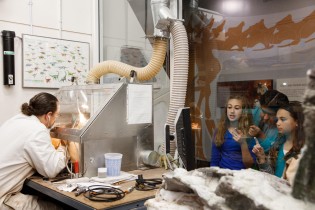
For a true behind-the-scenes experience, come witness the exciting dinosaur preparation process in the second floor Dino Lab. Sneak a peak at real fossils and see our staff working on the day-to-day details. Everything you see in the lab is real. And, in case you’re itching to make first-hand contact with some of these incredible fossils yourself, we’ve provided a footprint and toe bone of a T. rex — real fossils that are 66 and 120 million years old that you can actually touch.
Excursions into the field allow us to grow the Museum’s fossil collection and continue our work as paleontology detectives. Each new fossil we find provides additional clues for understanding dinosaurs and their world. Fossils discovered in the field are removed from the dig site, along with the surrounding rock, and encased in big white plaster “jackets” for transport. Before the fossils can be studied or exhibited, Dinosaur Institute preparators remove the jackets and surrounding rock and then inspect and clean fossils for both research and display. Visit our Dino Lab and watch the process as we uncover details buried for millions of years.
When discovered in the field, dinosaur skeleton fossils are almost never complete. Paleontologists must sort out this puzzle in order to create a whole skeleton by using the bones of similar dinosaurs to help understand how to reconstruct and restore the missing pieces. Dinosaur preparatory staff members, like Doyle, restore specimens by sculpting the missing bones.
The Museum is in the process of creating a thorough photographic archive of the fossils we prepare in our Dino Lab. Comprehensive fossil imagery offers indispensable guidance with research and exhibition development to this and other institutions. Stephanie, the Dinosaur Institute’s scientific illustrator, documents fossil discoveries in our lab and out in the field.
This tridactyl (three part) footprint’s broad short toes indicate that the dinosaur whose foot made the impression was a plant-eating biped known as an ornithopod. Our footprint specimen is 120 million years old and was collected in southeast Utah. We call this a “natural mold” where the depression of the prehistoric footprint was filled in with sediment that consolidated into rock, making a mold of the footprint in the process. This specimen is part of our Dino Lab exhibit and is on display as a touchable object.
T. rex had three main toes and made a tridactyl footprint. This adult T. rex toe bone is the animal’s middle toe and is approximately eight inches long. This specimen, collected in northeastern Montana in the 1960s, is part of our Dino Lab exhibit and is on display as a touchable object in the meantime…